
For Contractors: Why Showing Them the Finished Job Beats Quoting a Price
Two contractors get the same inquiry on a Saturday morning. Both reply within ten minutes.
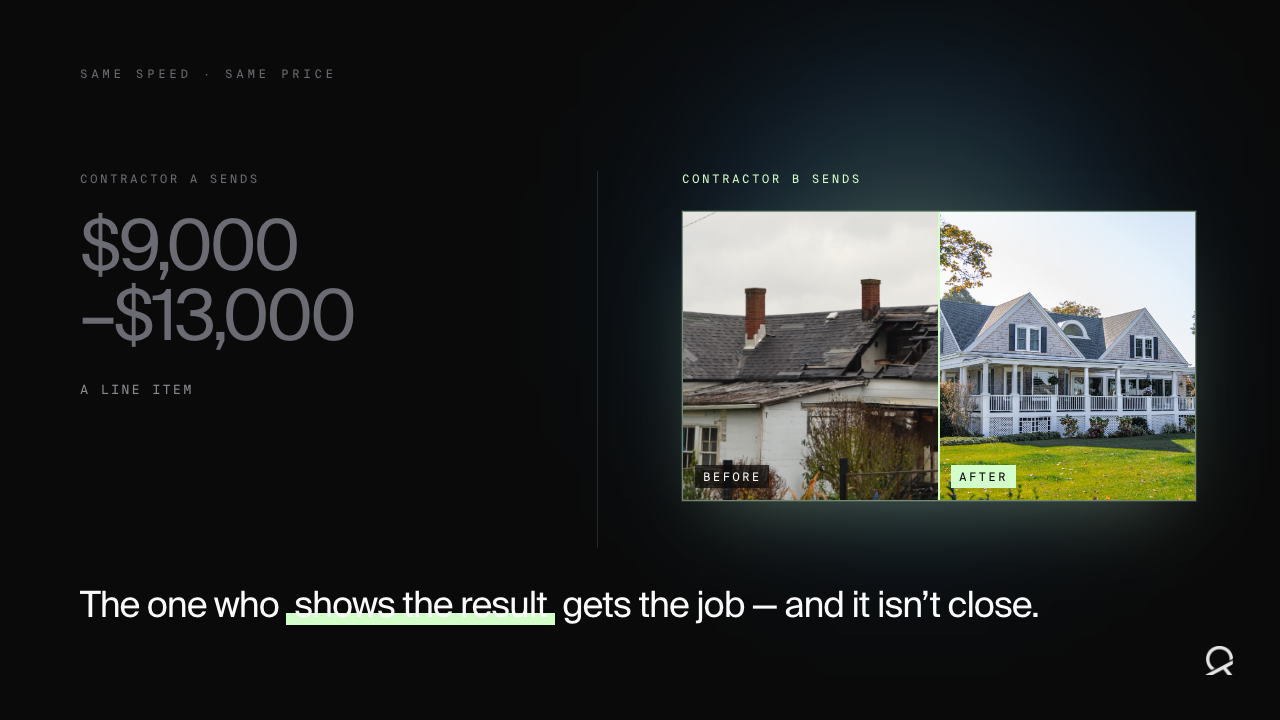
The first sends a price range. Somewhere between $9,000 and $13,000, happy to come out and take a look.
The second sends a picture of the customer's own house with the new roof on it, and a price range.
Same speed. Same price. The second one gets the job, and it is not close.
Speed got both of them into the race. Only one of them won it. This piece is about the difference, because it is the thing almost nobody talks about when they talk about responding fast.
Speed gets you the conversation. Specificity wins it.
We have written elsewhere about why the fastest business wins, and we stand by all of it. If you are not in the first conversation, you are a challenger to whatever the first conversation established.
But being first is a qualifier, not a victory. Once you are in the room, something else decides the outcome, and it is not your price.
A price is a commodity signal
Think about what a bare number actually does to the person receiving it.
They asked about their house. You sent them a figure. Now the only thing they can do with that figure is compare it to another figure. You have handed them a spreadsheet and invited them to shop you, and in a spreadsheet the cheapest number wins.
This is the trap. You responded fast, you were professional, you gave them exactly what they asked for, and in doing so you turned yourself into a line item.
Worse, the number arrives with no confidence attached to it. The homeowner has no idea whether $11,000 is fair, whether you understood the scope, whether you noticed the section over the garage that is going to be a problem. They cannot evaluate the number. So they do the only thing they can, which is get two more numbers.
What they are actually buying at that moment
Here is the honest truth about the person on the other end of that message.
They are not price shopping. They think they are, and they will tell you they are, but that is not what is happening. They are anxiety shopping.
The questions in their head are not about cost. They are:
Does this person understand my house, or are they guessing?
Are there going to be surprises once the work starts?
Am I about to hand a large amount of money to someone who is going to disappear or do it badly?
Do they even know what my place needs?
Price is the only vocabulary they have for that anxiety, so price is what comes out of their mouth. But cost is not the friction. Uncertainty is the friction. And a number, on its own, does absolutely nothing to reduce it.
Why showing the finished result collapses all of it
Now think about what the second contractor sent.
A picture of their house. Their actual house, from the street they park on every day, with the new roof on it.
Nothing has been argued. No case has been made. No trust has been claimed. And yet in about two seconds the homeowner has concluded that this person looked at her house, understood the job, and can see the outcome clearly enough to show it to her.
That is the mechanic, and it is worth being precise about it. When you can show someone their problem already solved, they credit you with knowing how to solve it. You have not told them you are competent. You have demonstrated that you have already thought about their specific situation, which is the only evidence of competence they are actually able to evaluate.
It also does something a price can never do. It moves the picture in their head from risk to result. She stops imagining what could go wrong and starts imagining the house finished. Once she is imagining the finished house, she is not shopping any more. She is planning.
The other two quotes now arrive as numbers, into a mind that has already seen the ending.
The response ladder, honestly ranked
Not every rung is worth the same, and each one costs more to build than the last. Here is where we would actually put them.
Autoresponder. "Thanks, we'll be in touch." Instant and worthless. The customer knows what this is. Arguably worse than silence because it proves you saw the message and did nothing.
Templated human reply. Fine. Genuinely fine. If you are currently taking two days, a saved reply that goes out in five minutes is the single highest-return change you can make, and it costs nothing.
A real conversation. Good. Now you are qualifying, answering, and booking. This is where most people should stop and be happy, and it is where a well-built AI concierge lives.
An instant price band. Better, but only if it comes with the reasoning. A number with a "here's what that covers and here's what would change it" is a different object from a naked number.
A price band plus a visual of their property, finished. Best. Expensive to build, and it does not apply to everyone, which we will come to. But where it fits, nothing else is close.
Most businesses are on rung one and think their problem is rung five. Their problem is rung two.
Where this does not work, and you should not fake it
We are not going to pretend this is universal, because it is not.
It needs a visual outcome. Roofing, painting, siding, landscaping, remodels, driveways, fencing. Anything where there is a genuine before and after that a person can see.
If your service does not have that, do not manufacture one. A plumber cannot show you a beautiful picture of a repaired pipe inside a wall. An electrician cannot make a mockup of a compliant panel that means anything to a homeowner. Forcing a visual into a business that has no visual outcome produces exactly the kind of gimmick that makes people trust you less, and they will smell it immediately.
For those businesses the answer is not a picture. It is the conversation, done fast, done well, with someone who clearly knows the trade. Rung three. Take it seriously and you will beat everyone still on rung one.
And a bad mockup is worse than no mockup. This is the part that should worry you.
If you send a homeowner a rendering of a house that is not quite hers, with a roofline that does not match, in a colour she did not ask about, you have not built trust. You have proven you are running some automated thing that does not really look at anything, and you have done it in the exact moment she was deciding whether to trust you. That is a self-inflicted wound and it is very hard to recover from.
The quality bar is not optional here. It is the entire product. Either it is genuinely her house and it genuinely looks right, or do not send it.
What it actually takes
This is where most of these projects fall over, so we will be direct about it.
Sending an instant, accurate, visual response to an inbound inquiry is not one thing. It is several, and each one has to be right.
You need to reliably get the property. Address, photos, roof geometry, the right house and not the one next door.
You need to generate something that is genuinely accurate rather than decorative, which means the system has to be constrained by what is actually there rather than inventing a pleasant picture.
You need a price band that is grounded in your real numbers, not hallucinated. One invented figure that you then have to walk back is worse than never quoting at all, and depending on where you operate it may be worse than that.
You need it to know its own limits. Complex roof, unusual pitch, bad photos, an inquiry it cannot read. It has to hand off to a human cleanly instead of guessing, and it has to know the difference.
And you need to have tested it against hundreds of real inquiries before it ever meets a customer, because the failure mode is not that it breaks loudly. The failure mode is that it confidently sends something slightly wrong to someone who was about to give you eleven thousand dollars.
None of that is a software purchase. It is engineering, and it is the reason most "AI quoting" products are demos rather than businesses. It is also what our AI Estimator is built to do, and the reason we are comfortable listing every way this can go wrong is that we had to solve each one.
The bigger idea
The reason we build these is not that visuals are a clever marketing trick. It is that the whole thing, speed and accuracy and the picture and the price and the booking, is one system that a business can own instead of a person it has to hire.
Growth bottlenecks like this used to be solved with headcount. Now they are solved with engineering. That shift is what we call Engineering as Distribution, and a homeowner getting a picture of her finished roof at 9pm on a Saturday is what it looks like from the outside.
Key takeaways
Speed gets you into the conversation. Specificity wins it. Being first is a qualifier, not a victory.
A bare price turns you into a line item, because a number invites exactly one comparison and it is the cheapest number.
Your customer is not price shopping, they are anxiety shopping. Uncertainty is the friction, not cost, and a number does nothing to reduce it.
Showing someone their problem already solved is the fastest way to be credited with knowing how to solve it. It also moves them from imagining risk to imagining the result.
This only works where there is a real visual outcome, and a bad mockup is worse than none. The quality bar is the product.
FAQ
Isn't an instant estimate risky if I get the price wrong?
It is, which is why the number has to be a grounded range with clearly stated assumptions, not a false precision. A range that says what it covers and what would change it is honest and useful. A confident wrong number is a liability. If a system cannot tell you how it arrived at a figure, do not put it in front of customers.
Won't customers just take my visual and price and go shop it?
Some will, and they were never yours. But the effect runs the other way for most people. You are the one who showed them the finished house, which means every subsequent quote is being compared to your framing. You set the reference. That is worth far more than the small number of people who use you as a benchmark.
Do I need this if I already respond fast?
Maybe not. If you are already first into the conversation and closing well, your bottleneck is somewhere else and you should go fix that instead. This is for businesses who are getting into the race and still losing it.
How is this different from the online calculators everyone has?
A calculator asks the customer to do the work and then gives them a generic number about a generic house. This is about the response you send back to a specific person about their specific property, in the minutes after they reached out, while they are still deciding who to trust.
If you want to know whether this fits your business, our free AI audit maps where your inquiries are leaking and what it would take to catch them. No pitch, just the numbers.