
What Is GTM Engineering? The Discipline That Merges Marketing, Sales, and AI
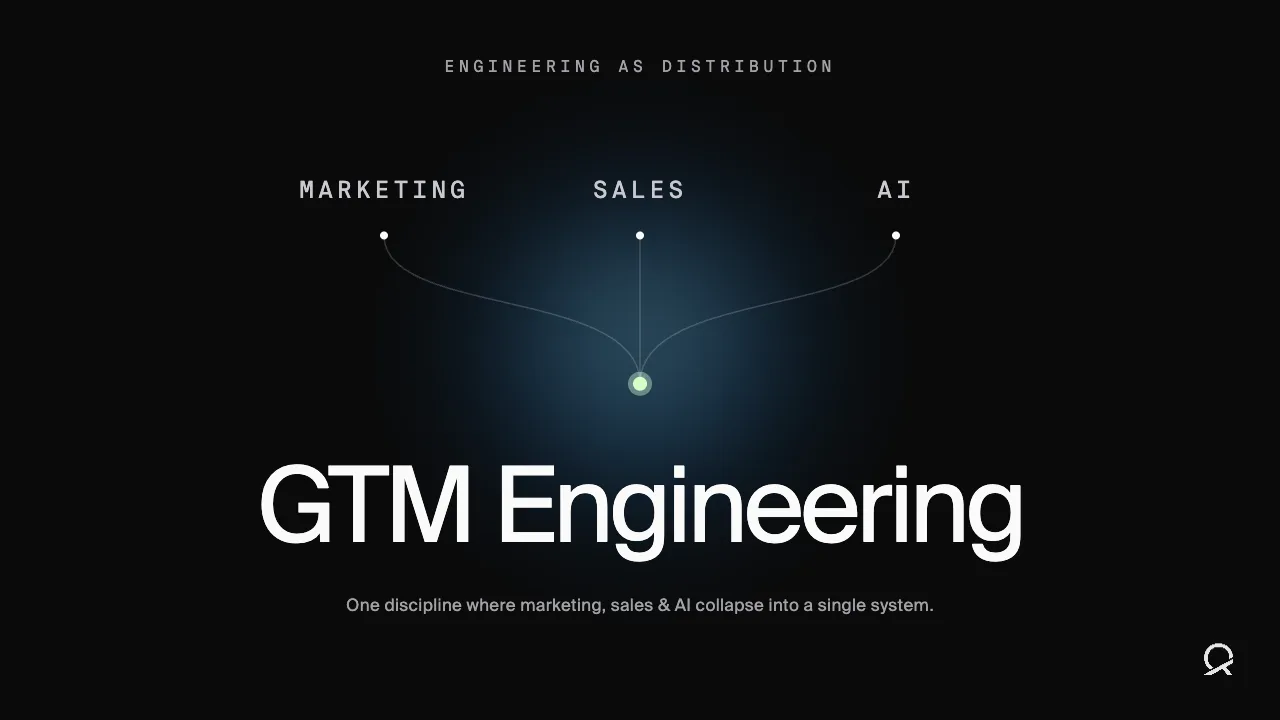
A new role is emerging. It is not a growth hacker. It is not a RevOps specialist. It is not a sales engineer. It is a Go-to-Market (GTM) Engineer, and it represents a fundamental shift in how companies think about distribution, across both B2B and B2C.
The Problem That Creates This Role
Most companies do not have a value problem. They have a distribution problem.
They know what they are good at. They know who they are for. They just cannot reach enough of the right people and convert them into paying customers, not without hiring more headcount, expanding org charts, and watching margins shrink.
The traditional response has been to throw people at the problem. More SDRs. More marketers. More tools. More complexity.
GTM Engineering is a different answer.
What GTM Engineering Actually Is
GTM Engineering is the cross-domain discipline that applies engineering principles to marketing and sales workflows. It sits at the intersection of three domains:
- Marketing. Understanding what makes messaging work. Knowing the difference between copy that converts and copy that gets ignored. Having the domain expertise to evaluate a creative, a landing page, or an email sequence with actual marketing judgment.
- Sales. Understanding pipeline, lead qualification, objection handling, and the human dynamics of closing deals. Knowing what happens after a prospect says "yes" and how to optimize every step of that journey.
- AI Engineering. Building the systems that execute at scale. Coding automations. Designing prompt architectures. Creating workflows that turn strategic intent into production output.
A GTM Engineer is not someone who knows how to use ChatGPT to write blog posts. A GTM Engineer is someone who can look at a marketing or sales workflow, understand it end to end, and build an AI-powered system that executes that workflow at 10x the volume with the same or better quality.
This applies across multiple domains. It could mean building an AI agent that reaches out to prospects with the right sales structure and scripts embedded in its logic. It could mean creating a system that analyzes ad performance data weekly and generates optimization recommendations based on ROAS, CPM, and click-through rates. It could mean architecting a CRM automation that triggers pre-call sequences when someone books a meeting, reducing no-shows through AI voice agents that confirm appointments.
The common thread is this: the person building these systems understands both what good looks like from a marketing perspective and how to make it happen from a technical one.
Why Now? Three Forces Converging
1. AI Makes Scale Possible
Three years ago, scaling a marketing operation meant hiring more people. Today, AI tools like n8n, Claude Code, and Codex allow a single operator to orchestrate workflows that previously required a team.
The bottleneck has shifted from execution capacity to strategic oversight. The question is no longer "can we produce enough content?" but "are we running the right campaigns, targeting the right audiences, and optimizing based on the right data?" That requires marketing judgment at the system design level.
2. The Gap Is Widening Between Tools and Strategy
Most marketing tools are point solutions. They scrape leads. They send emails. They generate images. They write copy.
But none of them replace the strategic thinking that ties these functions together. A lead scraped without context is noise. An email sent without understanding the prospect's pain point is spam. An image generated without marketing strategy is decoration.
GTM Engineering bridges this gap. It takes the tools that exist (AI agents, automation platforms, data pipelines) and embeds them with the right strategy, structure, and domain knowledge.
3. The Cost of Distribution Is Dropping
When a single operator can manage outreach that used to require a team of five, the economics of distribution change fundamentally. Companies that embrace GTM Engineering can reach 10–100x the audience at a fraction of the cost. They can onboard more clients without their margins taking a hit.
This is not about replacing people. It is about replacing the inefficiency that makes distribution expensive.
What GTM Engineering Is Not
It is important to draw some lines, because "GTM Engineering" is a term that is starting to be used loosely.
GTM Engineering is not:
- Just lead scraping and data management. There are tools that automate lead research and CRM enrichment. Those are useful. They are not the whole discipline.
- Just prompt engineering. Knowing how to prompt an AI model is table stakes. It is not the differentiator.
- Just RevOps with a new name. Revenue operations manages processes, data, and systems. GTM Engineering builds the systems themselves and embeds them with marketing strategy.
GTM Engineering is the combination of all three: technical skill to build, marketing judgment to guide, and sales understanding to convert.
Who Becomes a GTM Engineer?
The path into GTM Engineering is not yet standardised, but two profiles dominate:
Engineers who pick up marketing. They already know how to build. They learn what makes messaging work, how to structure a campaign, and what metrics matter.
Marketers who learn AI and code. They already understand the audience. They learn to build the systems that scale their existing expertise.
Both paths converge on the same outcome: someone who can design and operate revenue systems that run with minimal human intervention, where the human role is strategic oversight, not execution labour.
But not everyone should pursue this path. The honest take is more nuanced.
Marketers should learn AI skills, but most should not become GTM Engineers. Every marketer in 2026 should know how to use GitHub Copilot, Codex, n8n, and basic automations. That is table stakes. But becoming a GTM Engineer requires a fundamentally systems-oriented mindset, being operational, numbers-driven, and willing to go deep into the technical layer. If that describes you, the path is open. If you are a creative marketer who thrives on messaging, narrative, and campaign strategy, the better move is to lean into those strengths and partner with someone who builds the systems for you.
Engineers should learn marketing, and it is a serious commitment. The engineers who become great GTM Engineers do not just dabble in marketing. They spend months studying it. They apprentice at marketing agencies or ecommerce companies that do heavy marketing work. They build marketing systems for CMOs and creative directors until they start to think like a marketer. Only then can they translate marketing strategy into production-grade AI systems.
Product managers are a surprisingly natural fit. They already think about end-user outcomes. They understand both business needs and technical execution. The PM mindset, bridging stakeholder requirements with engineering reality, maps almost directly onto what GTM Engineering demands.
Our founder, Solomon, came from the marketer path. He started as a copywriter, writing emails, VSLs, and direct response copy for B2B companies. He studied the old masters (Eugene Schwartz, Gary Halbert, Joseph Sugarman, Ben Settle) and learned what makes people respond to messaging.
When ChatGPT emerged three years ago, he saw the opportunity not as a writing shortcut, but as a leverage point. He spent years reverse-engineering his own copywriting process (the inputs, the research, the structural decisions) and building AI systems that could replicate it at scale. That meant learning to code, understanding AI engineering, and eventually creating automated workflows that let him handle 5–6 clients instead of 2–3, spending 50% less time on each.
That arc from practitioner to system builder is the typical GTM Engineering journey.
How Marketing Teams Will Change
The emergence of GTM Engineering will reshape team structures. In the near future, a marketing team might look like this:
- Head of GTM / Marketing Director. Owns the strategy and the business outcomes.
- GTM Engineer. Understands marketing and sales workflows deeply enough to design and build the AI systems that execute them. This person does not just operate tools. They architect the entire system, from the input layer (data sources, transcripts, research) through the automation layer (AI agents, workflows, prompt chains) to the output layer (campaigns, sequences, reports).
- Copywriters and Designers. Become the quality assurance layer. They validate that what the GTM Engineer's systems produce meets the creative bar.
- AI Agents. Execute the production work under the systems designed by the GTM Engineer.
That said, a GTM Engineer who deeply understands marketing can, in some cases, absorb the copywriter and designer roles into their own workflow. The team shrinks. The output does not.
This is a new category of role, one that did not exist three years ago and will be increasingly common in the next three.
What This Looks Like in Practice
Two concrete examples make this real. One from the B2B side, one from B2C.
Example 1: Scaling Email Copywriting (B2B)
A GTM Engineer who understands copywriting built this system from scratch. Here is how it works.
First, they designed the input layer. A set of structured resources that capture everything needed to write on-brand copy:
- Persona research. A document capturing the target audience's fears, desires, needs, and wants. Where they are now. Where they want to be.
- Offer breakdown. A document that maps how the product or service bridges the gap between the persona's current state and their desired state.
- Voice samples. A swipe file of existing copy written in the brand's tone of voice, including email sequences, social posts, and landing pages.
- Content transcripts. For influencer-led brands, transcripts of YouTube videos where the founder teaches their concepts. These capture two things at once: the unique mechanism behind their philosophy, and the actual way they speak.
- Antipatterns. A specific list of patterns the AI must avoid. Certain sentence constructions, formatting choices, and generic phrasing that sound like AI-generated text.
- Structural templates. Frameworks for different email types, with clear rules on where the hook goes, where the CTA lands, and how to connect narrative to offer.
All of these inputs live in a centralized folder. The GTM Engineer built an AI coding environment pointed at that folder, with a configuration file and a set of custom skills (content planner, email writer, editor) that encode the strategic rules. The engineer designed the entire architecture of how inputs flow into outputs. This is not a tool they operate. It is a system they built from the ground up, guided by their deep understanding of what makes copy work.
The weekly workflow runs on top of this architecture:
- A weekly call happens with the founder. They share what they did, learned, or experienced.
- The call transcript goes into the system alongside any new content they published.
- The AI generates a content plan tied to recent events and the product.
- The GTM Engineer reviews the plan, applies their marketing judgment, and refines it. This review is possible only because they designed the system and understand exactly where judgment is needed versus where the automation is solid.
- The AI drafts the emails following the structural templates and antipattern rules.
- The GTM Engineer reads, edits, and approves (human in the loop).
- The emails go into the autoresponder.
The engineer is not just running this process. They built it. It only works because they understand both email copywriting deeply and how to engineer AI systems that reproduce good judgment at scale.
The result: one person managing 5–6 brands instead of 2–3, writing more per week, spending 50% less time on each.
Example 2: Ad Creative Optimization (B2C)
Now consider an ecommerce brand running Facebook and Instagram ads. A GTM Engineer might build a system that:
Pulls ad performance data (ROAS, CPM, CTR, frequency) on a weekly schedule. Feeds that data into an AI agent that analyzes which creatives are working and why. Generates recommendations on which ads to turn off, which to scale, and what new variations to test. Creates new ad copy and visual briefs based on what the data shows is working.
The GTM Engineer designed this system. They understand what metrics matter in ad buying. They know what a good creative looks like. And they built the technical infrastructure to make it run automatically.
The Pattern
In both examples, the GTM Engineer does the same thing. They look at a marketing or sales workflow, understand it end to end, and build a system that executes it at scale. The system requires strategic oversight, but the production work happens through AI.
The Future
The companies that win in the next decade will not be the ones with the biggest marketing teams. They will be the ones that learn to engineer distribution.
GTM Engineering is still an emerging discipline. The number of people who genuinely combine marketing domain expertise with production-level AI engineering skills is small. But that is what makes it valuable. The window to establish authority in this space is open, and it will not stay open forever.
At Arkis, we believe that the next ten years belong to companies who treat engineering as distribution: as marketing, as sales, as the thing that lets a business reach more of the right people with less.
We call it Engineering as Distribution.