
Speed to Lead Calculator: What a Missed Inquiry Actually Costs You
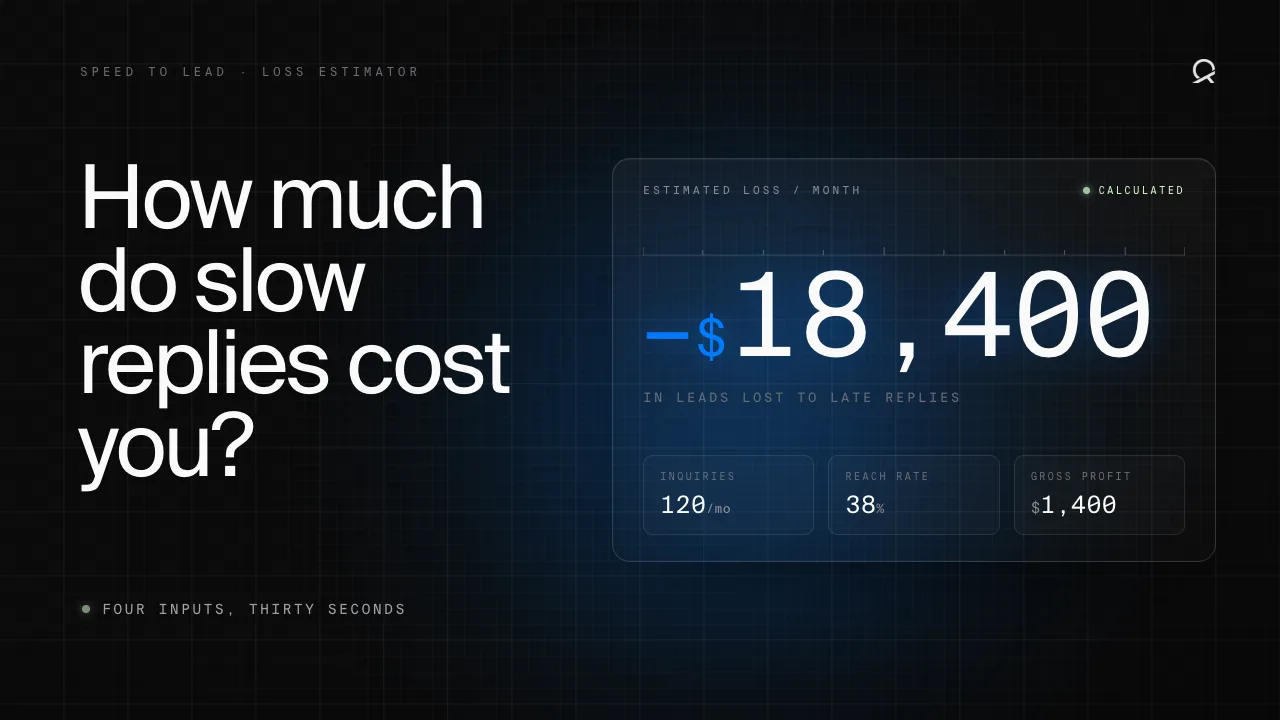
This lead response time calculator shows you what slow response is costing your business per year, in profit, using your own numbers. Four inputs, about thirty seconds. We show you the full formula rather than hiding it behind a black box, because a calculator you cannot check is just a sales pitch with arithmetic on it.
Enter your four numbers
What slow replies are costing you, and what answering every inquiry instantly would win back. Your numbers, every step of the math.
That’s $12,384 a month in gross profit lost to slow response — on demand you already paid to generate.
An AI answers in seconds, day or night, so fewer leads go cold waiting on your callback.
Be the first real conversation and you set the bar every other quote gets measured against.
Impossible until now — a person covers 40 of the week’s 168 hours. An AI covers all of them.
Free AI audit. No pitch, just the arithmetic on your data.
Monthly inquiries. How many people contact you in a typical month, across every channel. Calls, forms, texts, messages.
Current reach rate. Of those, what share do you actually get into a real conversation with. If you do not know, most businesses are between 50 and 65 percent, and most guess high.
Close rate. Of the conversations you do have, what share turn into a paying customer.
Average gross profit per sale. Profit, not revenue. What is left after the cost of doing the work. Use profit or you will lie to yourself and the number will be fiction.
Here is the formula, in full
No black box. This is the entire model, and you can run it on a napkin.
Sales per month = Inquiries x Reach rate x Close rate
Annual profit = Sales per month x Gross profit per sale x 12
That is it. The calculator runs that twice, once on your numbers today, and once with the reach and close rates you would expect if every inquiry got an instant, competent response. The difference between the two is your recovered profit. We assume a modest lift, not a miracle, because the honest version of this math is more persuasive than an inflated one.
Why speed moves two numbers, not one
Slow response leaks money in two separate places, and most people only count the first.
The reach leak. Inquiries you never speak to at all. They messaged, nobody got to them in time, they went quiet and hired someone else. These never appear in your CRM as losses. They do not appear anywhere.
The race leak. Inquiries you do reach, but late. You get the conversation, but you are the third quote, being compared against terms someone else already set. You close a smaller share of them.
Speed lifts both, which is why the compounding is larger than people expect. A 12-point lift in reach and a 3-point lift in close does not sound dramatic. Run it through the formula on real numbers and it usually lands in six figures, because it compounds against demand you already paid to generate.
If your number comes out small, believe it
We will say this plainly, because a calculator rigged to always produce a big number is exactly the kind of thing we spend our time arguing against, and people can smell it.
If you put in your real numbers and the result is small, then speed to lead is not your problem. A business with six inquiries a month at $600 a sale does not have a response problem, it has a demand problem, and the money belongs at the top of the funnel instead. Go get more people to reach out before you spend a cent on answering them faster. The math above tells you the truth in both directions. That is the whole point of showing you the formula.
What to do with the number
If the number is large, the next question is which part of the leak to fix first, and that depends on where your inquiries actually die. The reasoning behind all of this, why response time decides so many sales and why nobody could fix it until recently, is in what is speed to lead. If you want to see the same model run properly on your real data, that is exactly what our free AI audit does.
FAQ
How do I calculate the cost of slow lead response?
Multiply your monthly inquiries by your reach rate by your close rate to get monthly sales, then multiply by gross profit per sale and by 12. Run it at your current response time and again at instant response. The gap is your annual cost.
What is a good lead response reach rate?
Most businesses sit between 50 and 65 percent and overestimate their own number. Instant response typically lifts it into the low 70s, because fewer inquiries go dark before anyone gets to them.
Should I use revenue or profit in the calculator?
Gross profit, always. Using revenue inflates the result and gives you a number you cannot make decisions with. Profit is what a recovered sale is actually worth to you.
Want this run on your real data instead of estimates? Our free AI audit uses this exact model and shows where your inquiries are leaking. No pitch, just the arithmetic.