
What is speed to lead? Why the fastest business wins, and why nobody could fix it until now
Why the fastest business wins, and why nobody could fix it until now
Speed to lead is the time between someone reaching out to your business and you actually responding.
It decides more of your sales than your pricing, your reviews, or the quality of your work. That is not a controversial claim. It has been measured, published, and repeated for nineteen years.
And almost nothing has changed. That is the interesting part, and it is what this piece is actually about.
The short answer
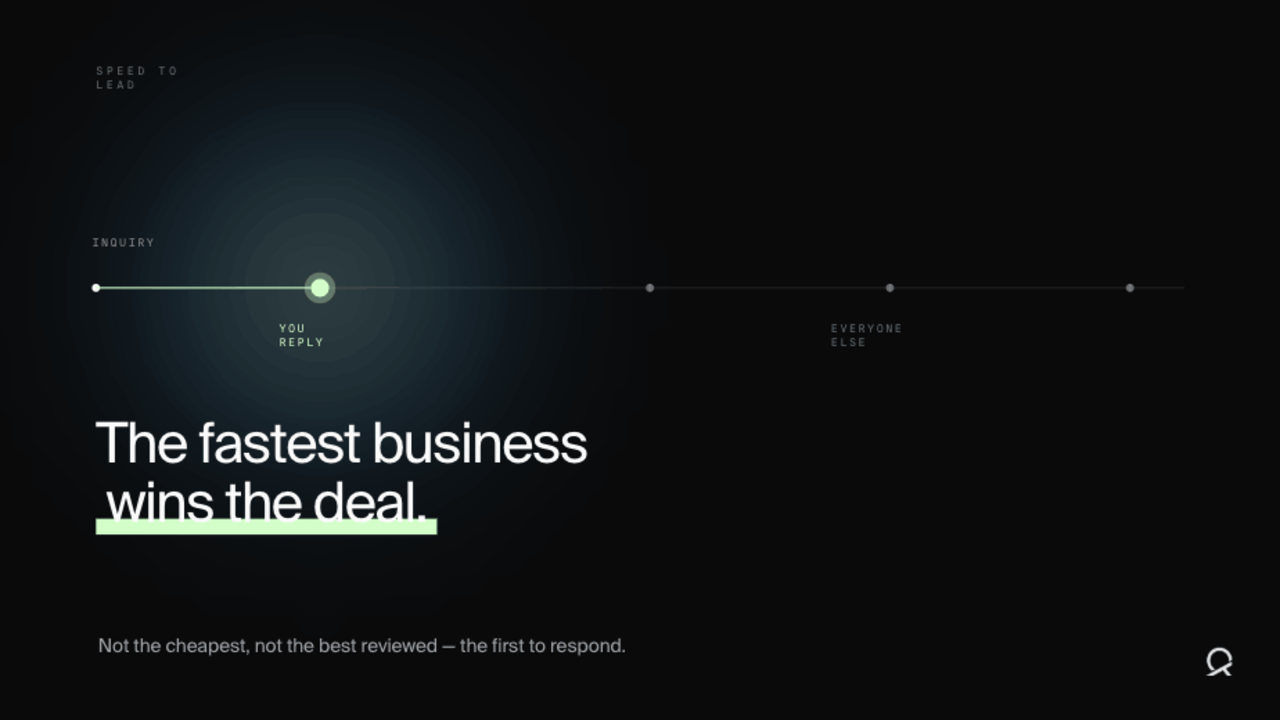
Buyers do not contact one business. They contact three to five in a sitting and deal with whoever comes back first.
At that moment they cannot compare your craftsmanship, your expertise, or your price, because they have not spoken to anyone yet. They are comparing exactly one thing, which is who showed up. The first business to hold a real conversation sets the expectations, defines what a good solution looks like, and becomes the reference every later quote gets measured against.
Everyone after that is a challenger. Most businesses are not even in the race.
Nineteen years of knowing, and it got worse
In 2007, an MIT study run with InsideSales.com found that the odds of reaching a lead drop roughly 100x if you call at 30 minutes instead of 5. The odds of qualifying one drop about 21x.
In 2011, Harvard Business Review audited 2,241 US companies and found the average business took 42 hours to respond to an inbound lead. Nearly a quarter never responded at all.
Those numbers have been quoted in every sales article written since. And the average response time today is not better. Depending on whose benchmark you read, it is roughly the same or worse.
Sit with that. Nineteen years. Everybody knew. Nothing improved.
Which tells you it was never a knowledge problem.
It was a physics problem
Here is why the advice never worked.
There are 168 hours in a week. A person covers about 40 of them. Your inquiries do not arrive during those 40 hours, because your customer is also working during those 40 hours. They contact you in the evening, on the weekend, at 9pm, when they finally have a minute to deal with the thing that is bothering them.
And you, at that moment, are on a roof, in a meeting, in a showing, with another client, or asleep.
Every solution anyone offered ran into that same wall.
Try harder. You are already at capacity. Speed is not a motivation problem.
Hire office staff. They cost real money and they go home at six. The Saturday inquiry still waits until Monday.
Use an answering service. They take a message. A message that waits for you to call back is still a slow response.
Set up an autoresponder. Instant and worthless. "Thanks, we'll be in touch" is not a conversation, and the customer knows it.
The advice was correct and useless at the same time, which is the most maddening combination in business. Everyone told you to respond in five minutes. Nobody could tell you how.
That is why the number never moved.
What it is actually costing you
Before the fix, the size of the hole. This is worth doing properly, on your own numbers, because the answer is usually much bigger than owners expect.
Speed leaks money in two separate places.
The reach leak. Inquiries you never have a conversation with at all. They messaged, nobody got to them in time, they went quiet. These do not appear in your CRM as losses. They do not appear anywhere.
The race leak. Inquiries you do reach, but late. You get the conversation, but you are the third quote, anchored against someone else's terms. You close a smaller share of them.
Four numbers, and you can get all of them this week.
L: inquiries per month.
R: your reach rate, meaning what share of them become an actual conversation.
C: your close rate on the conversations you have.
V: average gross profit per sale. Use profit, not revenue, or you will lie to yourself.
Sales per month = L × R × C. Run it at today's response time, run it at five minutes, and take the difference.
A worked example
30 inquiries a month, $8,000 gross profit per sale.
Today. You reach 60% of inquiries and close 25% of those. 30 × 0.60 × 0.25 = 4.5 sales a month.
At five minutes. Reach climbs to 72%, because fewer leads go dark before you get to them. Close climbs to 28%, because you are more often the first conversation instead of the third. 30 × 0.72 × 0.28 = 6.05 sales a month.
That is 1.55 extra sales a month. $12,400 a month. Roughly $149,000 a year.
Notice what those assumptions are not. We did not assume you reach everyone. We did not double your close rate. That is a 12-point lift in reach and a 3-point lift in close, and the number is still six figures, because it compounds against demand you already paid to generate.
That money is not out there in the market somewhere. It already came to you. You just were not there when it arrived.
And you will never see it on a report, because nobody tells you they picked the faster company. The lead just goes quiet, and a quiet lead looks exactly like a lead that was never serious. Which is the story most owners end up telling themselves.
The wall just came down
This is the first moment in nineteen years that the arithmetic actually changes.
An AI agent can hold a real conversation at 3am on a Sunday. Not a phone tree. Not an autoresponder. It answers the inquiry instantly, asks the questions you would ask, answers the ones they ask, and books the appointment into your calendar while their intent is still hot.
168 hours of coverage, for a fraction of one salary. The thing that was structurally impossible for two decades is now a build.
That is genuinely new, and it is why speed to lead is worth your attention now in a way it honestly was not five years ago. The problem did not change. The solution became possible.
The new bottleneck is not speed. It is trust.
Here is the part almost nobody talks about, and it is the whole game.
Once responding instantly becomes easy, speed stops being the hard problem. A fast, stupid response is not an improvement. It is a faster way to lose the sale, and it is worse than silence, because now you have actively embarrassed yourself in front of a customer instead of merely disappointing them.
The bar moves. The question is no longer how fast can you answer. It is:
Is it right? Does it quote real numbers, real availability, real scope? One hallucinated price is a legal problem, not a marketing problem.
Is it consistent? Does it say the same thing on Tuesday that it said on Sunday?
Does it actually sell? Does it qualify the way your best closer qualifies, gather what you need to quote, and move the person forward? Or does it just chat pleasantly and hand you a name?
Does it know when to stop? Does it hand off cleanly to a human at the edge of what it can handle, or does it improvise?
This is where nearly every AI lead-response project fails, and it is why so many owners have tried "an AI thing" and come away with nothing. They bought speed. Speed was never the hard part.
Reliability is the hard part. And reliability is not something you get by picking a better model. It comes from the system built around it, the rules it operates under, the sales process encoded into it, and the tests that prove it behaves correctly before it ever talks to a customer.
That is not a software purchase. It is an engineering discipline, and it is the one we practise.
Where it does not pay
One honest caveat, because you should not take our word for any of this.
Run the model. If you get six inquiries a month at $600 a sale, the arithmetic gives you a few hundred dollars a month, and a system to capture it eats most of that. You do not have a speed problem. You have a demand problem, and you should spend the money on the top of the funnel instead.
Speed to lead is worth serious money when you have volume, deal value, or both. It is worth very little when you have neither. Anyone who tells you it is urgent for every business without asking your numbers first is selling you something.
What this looks like in your industry
The mechanism is universal. The economics are not.
Trades and home services. High volume, mid deal value, a decision window measured in hours. The homeowner with a leak is triaging, not researching. Speed gets you the conversation, but specificity wins it, because what she actually wants to know is whether you understand her house.
Real estate. The sharpest case that exists. A buyer inquiring on your listing is inquiring on four listings in the same ten minutes, from a phone. And you cannot answer a phone during a showing. One recovered deal a year pays for the fix many times over.
Financial advisors and regulated professions. The exception that proves the rule. Low volume, very high lifetime value, long decision window. First-touch speed matters less here than anywhere else. What kills advisors is the graveyard of prospects who said "let me think about it" three years ago and were never contacted again. That is a persistence problem, and it needs a different system.
Marketing agencies and B2B services. Mid volume, high deal value, longer window. Your prospect is comparison-shopping four vendors. Responding first does not just get you the meeting, it lets you set the criteria every competitor after you gets judged against.
B2B and SaaS. The enemy is not slowness, it is the queue. Form fill, CRM, assignment, template, call in two days. Every handoff is a place intent leaks out. The lift comes from instant qualification and letting a qualified buyer book straight into a calendar at the moment they raise their hand.
We are writing a piece on each of these.
The bigger idea
A missed inquiry is not a sales failure. Nobody on your team is doing anything wrong. It is a coverage problem, which makes it a systems problem, which makes it something you build rather than something you hire around.
That shift, treating growth bottlenecks as engineering problems instead of headcount problems, is what we call Engineering as Distribution. Speed to lead is usually the first and cheapest place to apply it, because the demand is already there and already paid for.
You are just not picking up.
Key takeaways
Speed to lead decides sales before price or quality get a chance to. Buyers contact several businesses and buy from whoever holds the first real conversation.
Everyone has known this since 2007 and response times have not improved. It was never an information problem. It was a coverage problem, and a person covers 40 of the week's 168 hours.
AI is the first thing that actually removes that constraint. That is what makes this urgent now.
Speed is now the easy part. Reliability is the hard part. A fast, wrong answer is worse than silence.
Run the model on your own numbers. Inquiries × reach rate × close rate × gross profit. If the number is small, fix demand instead.
FAQ
Is responding in five minutes actually realistic?
Not manually, and that is the entire point of this article. Good process gets you close during working hours. The other 128 hours need a system, because you are asleep.
Do customers mind talking to an AI?
What customers mind is silence, and being made to feel stupid. A fast, accurate reply that answers their question and offers them a time beats a voicemail every single time. The failure mode is not that it is automated. It is that it is useless.
How do I stop it from saying something wrong to a customer?
This is the right question, and it is the one most vendors will not answer straight. You constrain what it can say, you ground it in your real prices and availability, you define exactly when it hands off to a human, and you test it against hundreds of realistic conversations before it ever meets a customer. If a vendor cannot explain how they do those four things, do not let them near your inbox.
Is an answering service enough?
An answering service takes a message. The job is not taking a message. It is holding the conversation while intent is hot, qualifying, and putting a booking in the calendar.
What does this cost compared to hiring?
A system covers 168 hours a week for a fraction of a salary. Staff are better at judgment, relationships, and everything a script cannot hold. Coverage is not on that list.
If you want to know what slow response is costing you, our free AI audit runs this model on your real numbers and maps where inquiries are leaking out. No pitch, just the arithmetic.